
Posted
We have received Lisa’s permission to share her story.
Today, Lisa is a mom of three, college graduate, and community advocate for domestic violence survivors. Originally from the mid-west, Lisa lived in Kansas, Texas, California, and even spent time abroad in Germany. Today, she is proud to call Washington County home.
She originally landed in Washington County in 2010, but after several years Lisa moved to Lincoln County where she obtained a Housing Choice Voucher (HCV). With the support of the voucher, she was able to afford her own apartment while maintaining a part-time job working as a project manager for a copy-editing company, a position she still holds today.
The HCV program helps low-income individuals and families pay their monthly rent in privately owned apartments or houses. The tenant’s portion of the rent is paid directly to the property owner or manager, and the Housing Authority pays a portion of the rent as well.
Those two years in Lincoln County were extremely challenging. She was raising her two children while experiencing domestic violence and increasing isolation. The violence escalated to the point that Child Protective Services (CPS) became involved. Hoping to create greater safety and stability for herself and her children, Lisa returned to Washington County with her housing voucher. She wanted to be closer to family and friends, to care for her mother, whose health was declining, and for her children to have more time with their grandmother.
Like many survivors, leaving an abusive relationship was not a single event for Lisa, but a complicated process. On average, survivors return to an abusive partner seven times before leaving for good. A lack of safe, affordable housing is also one of the primary barriers survivors face when trying to leave an abusive relationship. Through the instability that followed, Lisa remained focused on creating safety and stability for her children. Having a housing voucher meant that even amid tremendous uncertainty, housing was one piece she could continue to provide.
The period that followed became what Lisa describes as “the worst year of her life.” Her mother died, and the following day her children were temporarily placed in foster care. In the months that followed, Lisa was also navigating a pregnancy, all while continuing to work toward creating a safe and stable future for her family.
Lisa worked with CPS for approximately a year. Although her children were only out of her care for portions of that time, she spent much of that year navigating CPS, the foster care system, and the courts while working toward reunification and continuing to navigate the impacts of domestic violence. By October 2019, her children were fully reunified with her, and the CPS case closed in January 2020. A few months later, she welcomed her third child.
In January 2021, Lisa’s abuser died. In the years since, stable housing has given Lisa and her children the foundation to continue healing and rebuilding their lives.
Today, Lisa and her children are all living together under one roof, healing from years of instability and rebuilding their lives. For so long, Lisa was focused on meeting her family’s immediate needs and simply surviving.
She reflects on her time of instability and is grateful for where she is now. She is no longer fending off one crisis after another. “I no longer wake up to a barrage of horrible messages. I don't have to wonder what threat is coming next. I don't live in constant fear anymore. When you’re living in crisis, so many choices are driven by immediate needs and survival. Stable housing gave me the freedom to make decisions from a place of safety instead of fear and to shift my focus from surviving to healing.”
With the support of the Family Self-Sufficiency (FSS) program, an employment and savings incentive program for low-income families that have a housing voucher or live in public housing, Lisa worked closely with staff to achieve her goals. Stable housing also gave Lisa the opportunity to return to school.
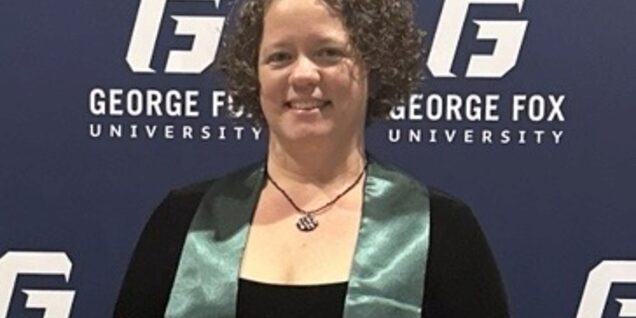
This past December, she graduated from George Fox University with a bachelor's degree in psychology and mental health studies. Drawing on both her education and lived experience, Lisa has become a survivor leader and community advocate.
In the aftermath of domestic violence, Lisa made it a personal mission of hers to ensure that people with lived experience have a seat at the tables where decisions affecting them are made. Today, she serves as Chair of the Survivor VOICES Advisory Committee at the Family Peace Center of Washington County, where survivors help advise center operations, empower other survivors, educate the community about family violence, and advocate for policy and systemic change.
Her community involvement also includes serving on the Head Start Policy Council, the FSS Program Coordinating Committee, the Community Action Organization Board of Directors, and as Vice Chair of her children’s school district’s Educational Equity Advisory Committee. Lisa has also used her lived experience to advocate for change at the state level, including testifying on legislation and contributing to efforts that resulted in changes to Oregon laws affecting survivors.
As we recognize Domestic Violence Awareness Month, we recognize the strength of survivors like Lisa, whose journey highlights both the challenges and the vital importance of support, safety, and community resources for those experiencing abuse. Safe, stable housing is one of the most empowering tools a survivor can have. When someone leaving domestic violence finds secure housing, they gain control, freedom from fear, and the stability to rebuild their life.
For Lisa, stable housing has provided far more than shelter. It created the conditions for her family to heal and grow, and for Lisa to contribute to her community and build a future that once felt impossible.
“Housing provides more than shelter—it provides the opportunity to rebuild a life.”