
What is the Strategic Prevention Framework?
The Strategic Prevention Framework (SPF) is an widely available and accessible community engagement model grounded in public and behavioral health principles developed by the Substance Use and Mental Health Services Administration (SAMHSA) to address local substance use and behavioral health challenges. Find out more about this model.
The SPF includes these five steps
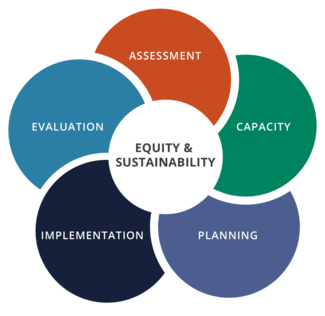
- Assessment: Identify local prevention needs based on data (e.g., What is the problem?)
- Capacity: Build local resources and readiness to address prevention needs (e.g., What do you have to work with? How can you facilitate the communication of prevention science?)
- Planning: Find out what works to address prevention needs and how to do it. (e.g., What should you do and how should you do it?)
- Implementation: Deliver data-based programs and practices as intended (e.g., How can you and your coalition put your plan into action?)
- Evaluation: Examine the process and outcomes of programs and practices (e.g., Is your plan succeeding?)
What is the Strategic Prevention Framework (SPF) Community Advisory Board (CAB)?
The SPF CAB will serve as the vehicle for implementing the Strategic Prevention Framework. It’s an ongoing collaborative effort to address substance use and behavioral health disparities among youth with a variety of backgrounds and lived experiences in Washington County. The SPF CAB will work on activities that aim to reduce the health, social, and economic harms of substance use through community engagement and effective prevention strategies.
The 2025 SPF CAB application submission period has now closed.
If you would like to stay connected to project updates and related opportunities, please fill out this form online.
SPF CAB Next Steps
| Date | Event |
|---|---|
| 8/18/2025 | SPF CAB Information Session (5-6 pm via Zoom). English recording and Spanish recording |
| 8/19/2025 | SPF CAB application opens |
| 9/5/2025 | SPF CAB application period closes |
| 9/22/2025 | All applicants notified of decision |
| Early October | Half-day retreat for new SPF CAB members (in-person) |
| Nov-June 2026 | Monthly CAB meetings held (virtual) |
Summary: April 2025 Kick-off Event
As part of the SPF initiative’s launch, the County’s Prevention and Behavioral Health programs hosted an in-person community needs assessment event in April 2025, inviting community members, partners and a variety of organizations to learn about the initiative while sharing their experiences and reviewing local data on substance use in relation to youth and young adults. Together, over 80 attendees and a total of 32 organizations:
- Better understood OHA’s four-year grant and the SPF on the whole.
- Went through publicly available data on opioid alcohol, opioid and polysubstance use and identified data gaps.
Collectively identified priority substance use problem(s) and affected population(s) based on five data factors (i.e., magnitude, severity, gaps in access or outcome, trend and comparison) You can find data summaries from the kick off event on this page in English and Spanish:
Resources
- Strategic Prevention Technical Assistance Center (SPTAC)
- Sign up to receive monthly Live Well Prevention Digest emails by contacting: [email protected]. The monthly digest includes information about community events, trainings, grants, and other content related to PACES (Positive and Adverse Childhood Experiences), substance use and gambling prevention, suicide prevention, and mental health promotion.