
Shelter Programs

Shelters are the “front door” of our homeless system of care. They provide emergency services such as hygiene, nutrition, safe sleep, and housing placement.

To provide a comprehensive system of care, various shelter models are needed to meet the needs of Washington County residents experiencing homelessness. Not all models are right for everyone.

The following are our shelter models:

  • Bridge shelters: private shelter rooms for families and people with disabling conditions
  • Congregate shelters: emergency shelter with shared living and sleeping accommodations
  • Alternative shelters: such as safe rest pods or pallet homes
  • Youth shelters: for unaccompanied youth under 18
  • Winter and Severe Weather Shelters: added emergency shelter capacity during severe weather events

See the map below of existing and future shelters in Washington County.
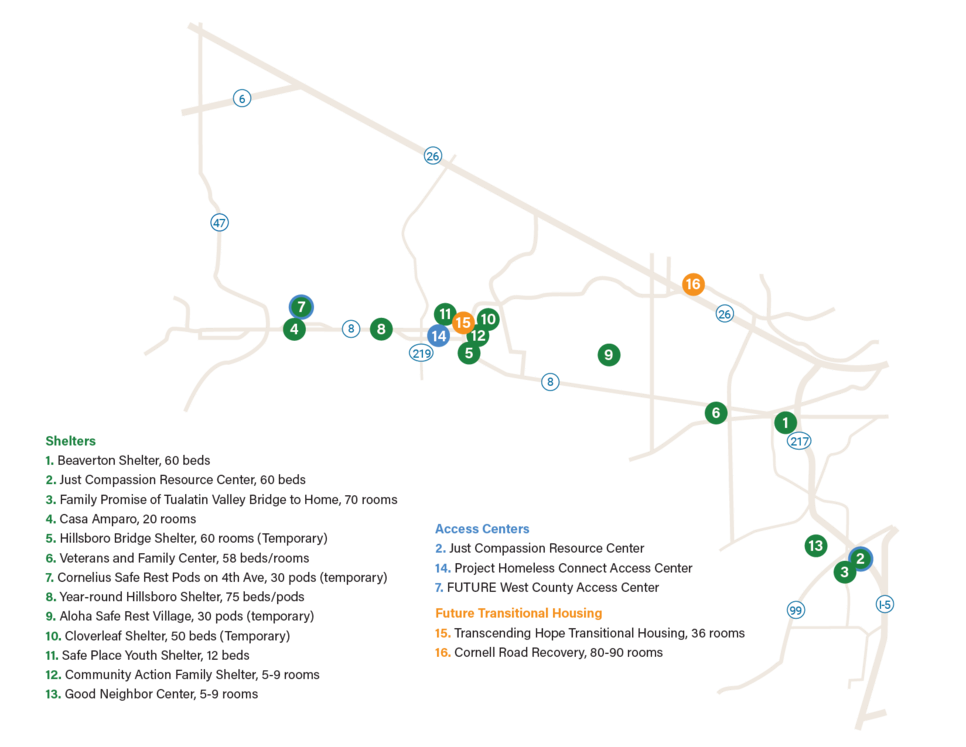
Map of shelter, access centers and transitional housing locations in Washington County

To access emergency shelters, please contact Community Connect at 503-640-3263 or work with your case manager at one of these partner organizations.

Background

Prior to 2021, funding for emergency shelter in our county was extremely limited. Shelter was only available for adults experiencing homelessness at rotating locations during the winter months, with no year-round options available for individuals. That has changed thanks to the voter-approved Supportive Housing Services measure.

Service expansion for unhoused people is rapidly growing as the County threads together existing resources, supported by a significant increase in funding. With these new and existing resources, Washington County now offers more than 430 shelter beds.

These shelters provide a low-barrier stepping stone that offers initial stabilization as our shelter guests move towards long-term housing solutions. Washington County has supported thousands of people who have moved from homelessness into stable housing thanks to these shelters.

FAQs

When we choose homeless services facility locations, we look at many factors to make sure they work well for the people who will live there and for the surrounding neighborhood. Washington County applies Board-approved Siting Guidelines when determining location of homeless facilities.

We looked at the location in relation to existing services in Washington County, the potential community impact and consider how close it is to public transportation, grocery stores, and job opportunities, things that will help program participants be successful. Other considerations include property size and location, geographic distribution of homeless services facilities, and the condition of the building. Washington County moved forward with this location because of the immediate need for recovery-focused transitional housing, paired with the rare opportunity to purchase a well-maintained hotel with accessible public transportation, healthcare, and recovery services including the Beaverton Recovery Center.

Here is a map of existing and planned homeless services facilities.

A map of Washington County's shelters

Participants are selected through a referral program; no walk-ins are accepted. There are 25 community-based organizations in Washington County that can refer someone to our shelter or future transitional housing programs, or individuals may contact Community Connect at 503-640-3263 and request a referral.

Right now, all County shelters have waitlists. Eligible individuals must be experiencing homelessness or at risk, have strong ties to Washington County, be 18 years of age or older, and agree to participate in recovery services and live in a 100% sober environment.

Washington County prioritizes low barrier shelters, which means background checks are not used to screen out guests.

Low barrier policies allow homeless individuals and households to access shelter, housing and services without preconditions such as sobriety, no pets, or agreement to participate in specific programs, activities or classes. This is a best practice to remove barriers to entering shelter, and in turn, reduces the number of homeless individuals in our community.

Shelter residents are required to follow a Code of Conduct. Violations of that code will lead to their removal from the program for a period of time. Below is a sample code of conduct:

Washington County shelters and transitional housing are staffed 24/7 by professionals who specialize in safety, housing navigation and employment assistance. Their goal is to help participants move toward stability by connecting them with long-term housing, mental health care and addiction treatment. Staff can also provide transportation or shuttle rides to public transit so guests can get to important appointments.

Shelters and transitional housing locations offer a safe space with meals, showers, bathrooms and essential supplies like clothing and hygiene products, everything needed so participants can focus on working toward a stable future.

House Bill 2006, Section 3. (1) states that “A local government shall approve an application for the development or use of land for an emergency shelter, as defined in section 2 of this 2021 Act, on any property, notwithstanding ORS chapter 195, 197, 197A, 215 or 227 or any statewide plan, rule of the Land Conservation and Development Commission or local land use regulation, zoning ordinance, regional framework plan, functional plan or comprehensive plan, if the emergency shelter…” authorizes local jurisdictions to site emergency shelters if certain conditions are met.

The law requires local governments to approve applications for emergency shelters regardless of state or local land use laws, if the application meets specific approval conditions outlined in the bill. Approval conditions include:

  • Sleeping and restroom facilities,
  • Meets applicable building codes,
  • Located within an urban growth boundary or in a rural residential zone,
  • Has adequate transportation access to commercial and medical services,
  • Will not pose any unreasonable risk to public health or safety, and
  • Will not result in a new building that is sited within an area designated under a statewide land use planning goal relating to natural disasters and hazards (e.g. flood plains or mapped environmental health hazards) unless the development complies with regulations directly related to the hazard.

Since the adoption of HB 2006, Washington County has used this legislation to site multiple shelters throughout the county.

Unlike an unmanaged encampment, a pod village shelter includes 24/7 staffing from a qualified shelter operator and meets all basic needs for shelter guests including lodging, food, water, and hygiene needs. This organically eliminates the “crimes of necessity” that are more common in unmanaged encampments. On top of provision of these immediate needs, the shelter operator also enters into a good neighbor agreement and provides a code of conduct for shelter guests. When shelter guests do not follow the Code of Conduct, they are exited from the program.

Finally, shelter staff and housing case managers are actively working with shelter guests to help them make the transition into long-term affordable housing. Shelter is just a temporary stop along the way towards long-term housing stability for program participants.

Funding for shelter locations comes from the Washington County Homeless Services Division. This division receives funding through the voter-approved regional Supportive Housing Services measure as its primary funding source, Continuum of Care funding from the federal government, and temporary funding from the Governor’s implementation EO-02 declaring a state of emergency related to homelessness.

Research on how shelters or transitional housing affect nearby property values is limited and inconclusive. A study by Portland State University’s Homelessness Research & Action Collaborative looked at four Portland neighborhoods with pod-style shelters. In three of the four neighborhoods, there were no significant changes in property values. The fourth showed a slight decrease, but researchers noted that other factors could have contributed to that change.

The Urban Institute recently shared an affordable housing case study brief from Alexandria, Virginia. They used Zillow data from 2000 to 2020 and adjusted for overall market trends. The study found that affordable housing has little to no negative impact on property values. You can read more research from the Department of Housing and Urban Development (HUD), Stanford, and New York University in an article from Bloomberg CityLab.

While data is not definitive, these findings suggest that shelters or transitional housing generally do not have a major impact on property values. Washington County remains committed to thoughtful site selection and ongoing community engagement to address concerns and support neighborhood stability.

Each County transitional housing site selects an on-site service provider through a competitive process. The service provider, Helping Hands, uses 24/7 staffing to monitor cleanliness and safety, often including perimeter fencing and security cameras.

Service providers work closely with local law enforcement to address safety and livability concerns. All participants staying in the program must sign a Participant Agreement (or Code of Conduct), which prohibits drugs and alcohol and sets behavior expectations on and around the site. Participants who break the Participant Agreement (or Code of Conduct) will lose their place at the homeless services facility.

Camping near the facility is not allowed and will be enforced by Helping Hands, County staff, and law enforcement in alignment with Washington County’s Time, Place, Manner Policy. This policy prohibits camping near homeless services facilities.

Together, these measures have been effective at other shelters across Washington County.

As always, all criminal activity should be reported to law enforcement officials, by calling 9-1-1 in emergency situations, or 503-629-0111 in non-emergency situations.

The Washington County Community Engagement Spectrum includes four levels of community engagement: inform, consult, involve and collaborate. The steps for community engagement in expanding shelter programs include each of these aspects:

  1. Public notification (Inform) – Surrounding residences and businesses are notified of plans to locate a shelter at the site and of upcoming community engagement meetings.
  2. Information & listening sessions (Inform, consult, and involve) – In-person or virtual meetings are held to introduce staff and partners to the neighborhood and gather feedback and concerns.
  3. Workshop (Consult and involve) – Site partners, law enforcement, County staff and neighbors gather to begin forming a Good Neighbor Agreement (GNA).
  4. Draft feedback (Involve)– The draft GNA is shared, and a virtual meeting is held to focus on feedback or questions about the document.
  5. Program launch (Inform)– Surrounding residences and businesses are again notified of the timeline for shelter operations to begin as well as the final GNA.
  6. Continued engagement – An additional community engagement session is held 3-6 months after the shelter opens to gather feedback about implementation and any needed amendments.

Community engagement opportunities will be posted on our Good Neighbor Agreements page and interested community members are also welcome to email us at [email protected].